Customer service representatives are at the center of an insurance agency's day-to-day operations.
They answer client questions, process service requests, review documents, follow up for missing information, coordinate policy changes, prepare certificates, update systems, and keep dozens of small tasks moving at the same time.
A lot of that work requires insurance knowledge and human judgment.
A lot of it does not.
This is where AI can be useful.
For insurance agencies, the best opportunity is usually not replacing the CSR. It is reducing the repetitive administrative work surrounding the CSR so they can spend more time handling exceptions, communicating with clients, and making decisions that actually require their experience.
Here are several practical examples of what that can look like.
A shared service inbox can contain dozens or hundreds of different types of requests.
A client may need a certificate of insurance. Another may want to add a vehicle. Someone else may have a billing question, request an address change, send a renewal document, or ask about an existing policy.
Without automation, someone has to open each email, understand what the sender needs, determine which client or account it belongs to, decide who should handle it, and route it appropriately.
AI can perform much of that first-pass work.
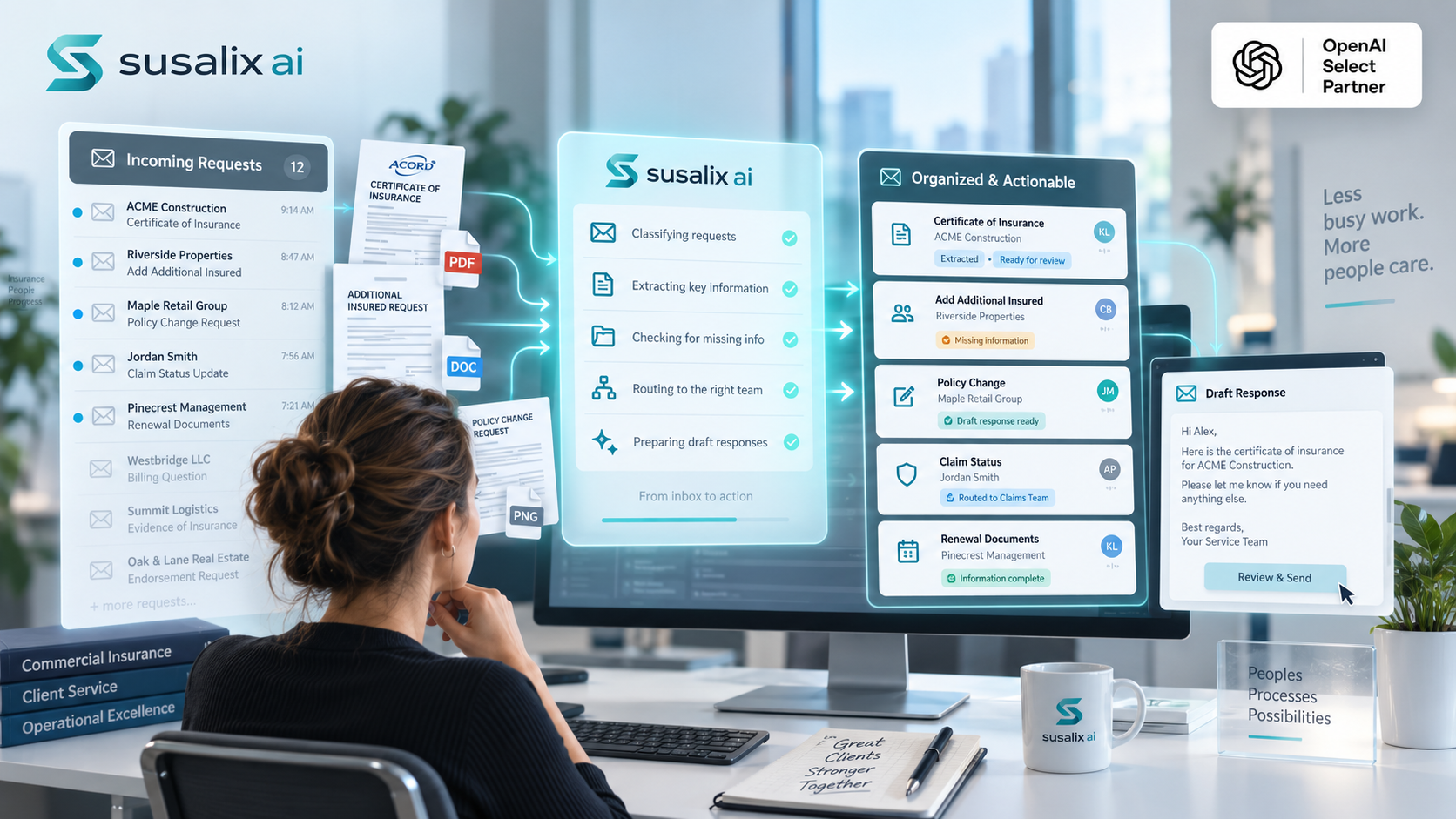
For example, an automated workflow could read an incoming email, identify that it is a certificate request, extract the client name and relevant details, classify the request, and route it to the appropriate CSR or service queue.
The CSR still handles the insurance work. They simply start with an organized request instead of an untouched email sitting in a general inbox.
That distinction matters.
AI does not have to replace the workflow. It can remove the repetitive first few steps of the workflow.
Many service requests arrive incomplete.
Someone might request a certificate but leave out the certificate holder information. A client might ask to add a vehicle without including the VIN. An endorsement request might be missing an effective date.
The CSR reads the request, notices what is missing, writes a response, waits for the client, and then returns to the request later.
AI can help identify those gaps immediately.
For example, the workflow could recognize that a vehicle-add request normally requires:
- Vehicle year, make, and model
- VIN
- Effective date
- Driver information when applicable
- Any other information required by the agency's process
If required information is missing, the system can flag the request before it reaches the CSR or prepare a draft email requesting the missing details.
The CSR can review the draft before anything is sent.
Instead of manually inspecting every request for completeness, the CSR spends more time dealing with requests that are actually ready to move forward.
Insurance service work is full of documents.
PDFs, applications, schedules, spreadsheets, policy documents, forms, and email attachments can all contain information that needs to be reviewed or transferred somewhere else.
AI document processing can help turn those files into structured information.
Suppose a client sends a PDF containing updated vehicle information.
Instead of a CSR opening the attachment, finding each field, and manually copying the information into another system, an AI workflow could extract fields such as the vehicle description, VIN, driver name, effective date, and other relevant information.
The extracted information could then be presented to the CSR for validation.
This is especially useful when the goal is not to let AI make an insurance decision, but to reduce the amount of reading, searching, and copying required before the CSR makes that decision.
Insurance CSRs often answer similar types of questions repeatedly.
That does not mean every client should receive an automatically generated response with no review.
It means AI can help with the first draft.
After reviewing an incoming request, an AI workflow could prepare a response based on the request type, information received, information still needed, and the agency's preferred communication style.
A CSR then reviews, edits, and sends it.
For example, if a client requests a policy change but fails to provide the effective date, the workflow could prepare a response asking for the missing information.
The CSR does not start from a blank screen.
For high-volume service teams, removing hundreds of small drafting tasks over time can create meaningful capacity.
Certificate of insurance requests are a good example of a workflow containing both repetitive administration and insurance-specific judgment.
AI can help with the administrative side.
A workflow might receive the request, classify it as a certificate request, extract the insured name and certificate holder information, identify special wording contained in the email or attachment, check whether required information appears to be present, and create a structured task for the CSR.
The CSR then reviews the request and handles the actual insurance work according to the agency's procedures.
This is an important principle for insurance automation:
Automate the preparation around the decision before trying to automate the decision itself.
That usually creates value with much less operational risk.
Endorsement requests create a similar opportunity.
A commercial client might ask to add or remove a vehicle, change an address, add a location, update a driver, change a mailing address, or request another policy modification.
These requests often begin as unstructured emails.
AI can convert that email into something much more useful.
Instead of:
"Hey Sarah, we bought another truck yesterday. Can you get it added to the policy? Details attached."
The workflow could produce a structured task containing the client, request type, vehicle information extracted from the attachment, requested effective date, missing information, source email, and assigned CSR.
The CSR receives the context needed to begin processing rather than spending the first several minutes assembling it.
Renewals can involve account history, prior emails, documents, missing information, client follow-ups, policy details, and notes spread across different systems.
The goal should not be to ask AI whether an account should renew or what coverage a client should purchase.
The better use case is preparation.
AI can help gather and summarize the information a CSR or account manager needs before beginning the renewal process.
For example, a renewal preparation workflow could summarize recent client communications, identify outstanding information requests, organize uploaded documents, highlight items requiring review, and create a cleaner renewal-preparation package.
The employee begins with context rather than spending the first part of the process searching for it.
Consider a typical incoming service request.
Traditional workflow:
Client sends email → CSR opens email → CSR determines request type → CSR checks attachments → CSR identifies missing information → CSR decides who owns the request → CSR enters information into another system → CSR drafts a response → work begins.
AI-assisted workflow:
Client sends email → AI classifies the request → AI extracts key information → AI reviews attachments → AI flags missing information → workflow routes or creates the appropriate task → AI prepares a draft response → CSR reviews the information → CSR takes the appropriate action.
The human has not disappeared from the process.
The human has moved further downstream, where their judgment is more valuable.
The value of this type of automation often comes from small amounts of time repeated at high volume.
Consider a simple hypothetical example.
Suppose an agency receives 60 service requests per day and the initial process of opening, reading, categorizing, and routing each request takes an average of two minutes.
That is roughly two hours of initial processing every business day.
Across 20 working days, that is around 40 hours of staff time per month before the actual service work even begins.
An automation does not need to eliminate all 40 hours to be useful.
If it reliably handles a significant portion of the first-pass processing while escalating unclear requests to staff, the agency can recover meaningful service capacity without changing the work that actually requires insurance expertise.
Actual savings will depend on request volume, workflow complexity, existing systems, and how much of the process can realistically be automated.
That is why the workflow should be measured before and after implementation rather than relying on generic AI productivity claims.
The most valuable AI strategy is not usually the one that automates the largest number of steps.
It is the one that automates the right steps.
Insurance agencies should be especially careful when a workflow affects coverage, claims, compliance, financial outcomes, or other high-impact decisions.
AI may help gather information, summarize documents, identify inconsistencies, organize requests, or prepare drafts.
Final decisions and higher-risk actions should remain subject to appropriate human review.
A practical automation system also needs exception handling.
If the AI cannot confidently classify a request, if information conflicts, or if something falls outside the expected workflow, the correct action may simply be to send the request to a CSR.
Good automation is not about pretending every situation can be automated.
It is about handling the predictable work efficiently and giving people a better starting point for everything else.
Do not begin by trying to automate the entire CSR role.
Start with one repetitive workflow.
Look for a process that happens frequently, follows a relatively consistent pattern, consumes measurable staff time, and involves a lot of reading, copying, organizing, routing, or follow-up.
For many commercial insurance agencies, that could be service inbox triage, attachment processing, certificate request intake, endorsement intake, or renewal preparation.
Document the current process first.
Measure how often it occurs, how much employee time it consumes, where delays happen, what information is required, what exceptions occur, and which steps genuinely require human judgment.
Then automate the repetitive portions while keeping the appropriate controls around the rest.
That is far more practical than trying to introduce AI across an entire agency at once.
The strongest AI use cases in insurance service operations are often surprisingly straightforward.
Read the request.
Classify it.
Extract the information.
Check for missing details.
Organize the attachments.
Route the work.
Prepare the draft.
Let the CSR handle the part that requires insurance knowledge, communication, judgment, and accountability.
That is the model Susalix AI focuses on.
As an OpenAI Select Partner, Susalix AI helps independent commercial P&C insurance agencies build practical AI automation around the systems and processes they already use.
The objective is not to put AI everywhere.
It is to find repetitive workflows where AI can remove unnecessary administrative work while keeping employees involved where their expertise matters.
If your CSRs are spending too much time reading emails, reviewing attachments, chasing missing information, routing requests, or manually moving information between systems, there may be a practical automation opportunity.
Schedule a free AI Workflow Assessment to see where AI automation can save your agency time.
Schedule a call to see where AI automation can save your agency time.
Schedule a callKeep reading