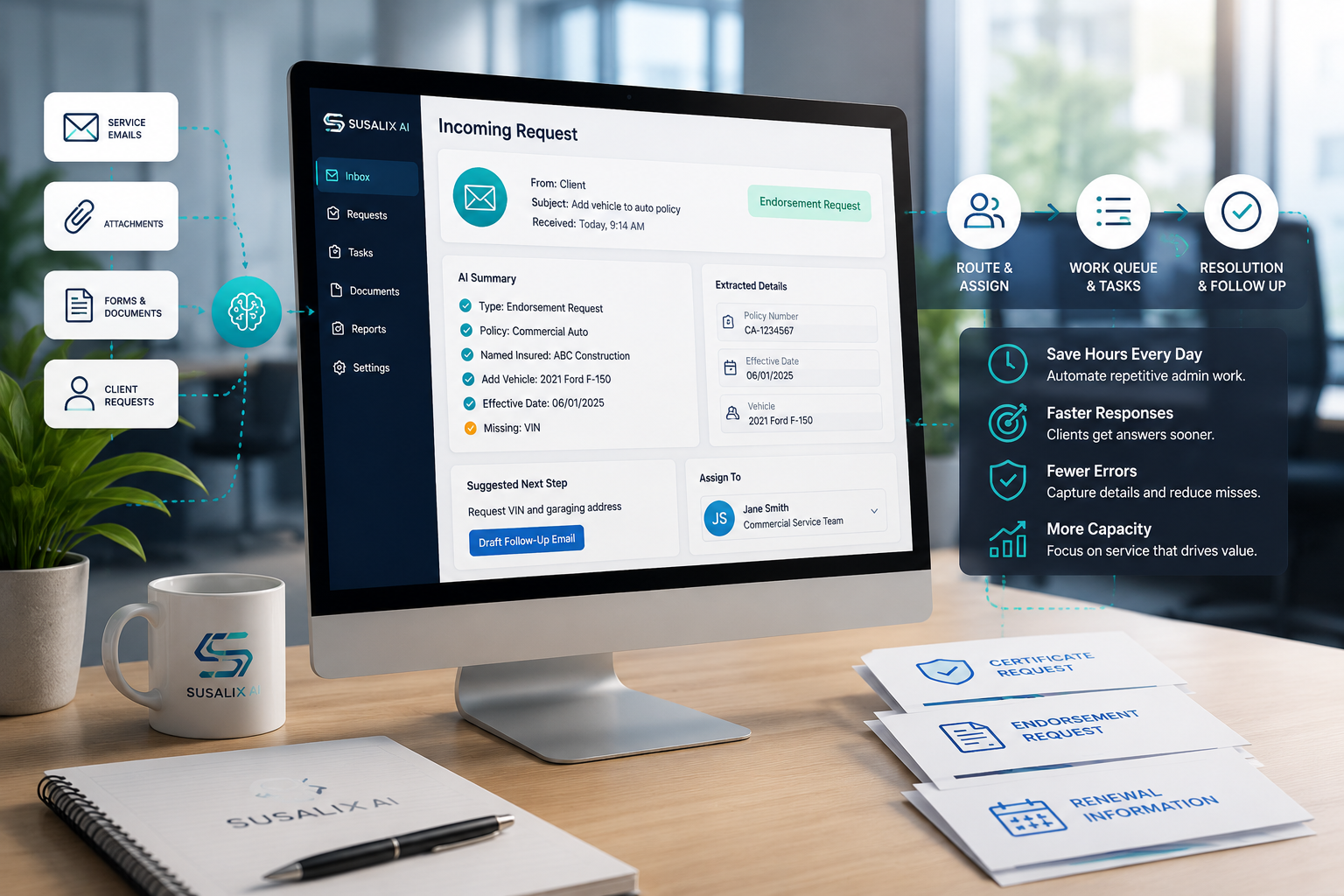
Commercial insurance service teams handle a constant flow of emails, documents, policy requests, follow ups, and internal handoffs.
The problem is not that every request is difficult. The problem is that even routine requests often require several manual steps before the real service work can begin.
Someone has to open the email, understand what the client needs, review attachments, identify missing information, enter details into another system, route the request, and prepare a response.
Multiply that across certificates, endorsements, renewals, billing questions, policy changes, and general service requests, and a large part of the team's day can disappear into administrative work.
AI automation can help reduce that workload by handling more of the repetitive first steps.
Where Service Team Workload Comes From
A typical commercial insurance service request may involve several small tasks:
- Reading the incoming email
- Determining what type of request it is
- Reviewing attachments
- Identifying the client or policy
- Pulling out important details
- Checking whether information is missing
- Deciding who should handle the request
- Creating or updating a task
- Drafting a response
- Following up if the request is incomplete
None of these steps may seem significant on their own.
The workload comes from doing them repeatedly, across dozens or hundreds of requests.
That is where AI can be useful.
AI Can Handle the First Pass
AI does not need to take over the entire service process to create value.
In many cases, the best use of AI is handling the first pass so the service team starts with an organized request instead of an unstructured email.
For example, an AI workflow could review an incoming message and identify:
- The type of service request
- The client or account
- Important dates
- Requested policy changes
- Relevant information from attachments
- Missing details
- The appropriate person or queue
- Whether the request may need urgent attention
The workflow can then organize that information and move the request to the next step.
The employee still handles the insurance work. They simply spend less time preparing the work.
A Before and After Example
Imagine a client emails the agency asking to add a vehicle to a commercial auto policy.
Without automation, an account manager or CSR may need to read the email, locate the vehicle information, determine whether an effective date was provided, check the attachments, identify the correct account, and create the appropriate task.
If something is missing, they may also need to write a follow-up email before the request can move forward.
With AI automation, the workflow could:
- Recognize the message as an endorsement request.
- Extract the vehicle details provided in the email or attachment.
- Check for information the agency normally requires.
- Flag anything that appears to be missing.
- Create an organized summary of the request.
- Route it to the appropriate service team member.
- Prepare a draft follow-up message if additional information is needed.
Instead of starting from the original email, the service team starts from a structured request that is ready for review.
That does not eliminate the account manager. It eliminates unnecessary preparation work around the account manager.
Document Review Is Another Major Opportunity
Commercial insurance service teams also spend significant time opening and reviewing attachments.
Applications, schedules, certificates, loss runs, policy documents, spreadsheets, and other files may contain information that needs to be found and entered somewhere else.
AI can help extract specific information from those documents and present it in a structured format.
For example, a workflow might pull out:
- Named insured information
- Effective dates
- Vehicle details
- Locations
- Payroll or exposure information
- Certificate holder details
- Requested changes
- Other fields relevant to the workflow
A team member can then review the extracted information instead of searching through the entire document manually.
AI Can Help With Missing Information Too
Incomplete requests create another layer of service work.
A certificate request might be missing certificate holder information. An endorsement request might not include an effective date. A renewal request may still be waiting on updated exposure information.
When employees have to manually identify what is missing and send the same types of follow-up messages repeatedly, the work adds up.
AI can help compare the information received against the information normally required for that workflow.
If something is missing, the system can flag it and prepare a follow-up message for staff review.
That helps move requests forward without requiring the service team to repeatedly start from scratch.
Keep Human Judgment Where It Matters
Reducing service workload does not mean allowing AI to make every decision.
Insurance workflows can involve coverage, policy changes, client communication, financial impact, and other areas where human judgment is important.
AI should be used to support the team rather than remove appropriate controls.
A practical model is:
AI reads, organizes, extracts, routes, and drafts.
People review, decide, approve, and handle exceptions.
That approach gives the service team more leverage without giving up control.
Start With the Service Inbox
Agencies do not need to automate every service workflow at once.
For many commercial insurance agencies, the service inbox is one of the best places to start because so many workflows begin there.
Certificates, endorsements, policy questions, renewal information, billing requests, documents, and general client questions may all arrive through the same inbox.
An initial workflow can help classify requests, review attachments, identify missing information, and route work to the right place.
Once that process is working, the agency can expand into more focused automation for certificates, endorsement intake, renewal preparation, document processing, and other repetitive workflows.
The Goal Is More Service Capacity
The biggest benefit of reducing administrative workload is not simply completing tasks faster.
It is creating more capacity for the work that actually requires an experienced insurance professional.
That can mean more time for:
- Client conversations
- Coverage discussions
- Renewal strategy
- Problem solving
- Account retention
- Producer support
- Complex service issues
The goal is not to make the service team work harder.
It is to remove some of the repetitive work surrounding the work they are already responsible for.
Where Susalix AI Fits In
Susalix AI helps commercial insurance agencies reduce manual administrative work by building practical AI workflows around their existing systems and processes.
As an OpenAI Select Partner, Susalix AI focuses on applying AI to real operational problems such as service inbox triage, document processing, request classification, task routing, missing information follow up, and human-reviewed draft responses.
The right place to start is usually not a large AI transformation.
It is one repetitive workflow that consumes meaningful staff time and can be improved without removing the human judgment your agency depends on.
Ready to Reduce Service Team Workload?
Schedule a call with Susalix AI to identify where AI automation could reduce repetitive service work inside your commercial insurance agency.
Book a Free Workflow CallKeep reading