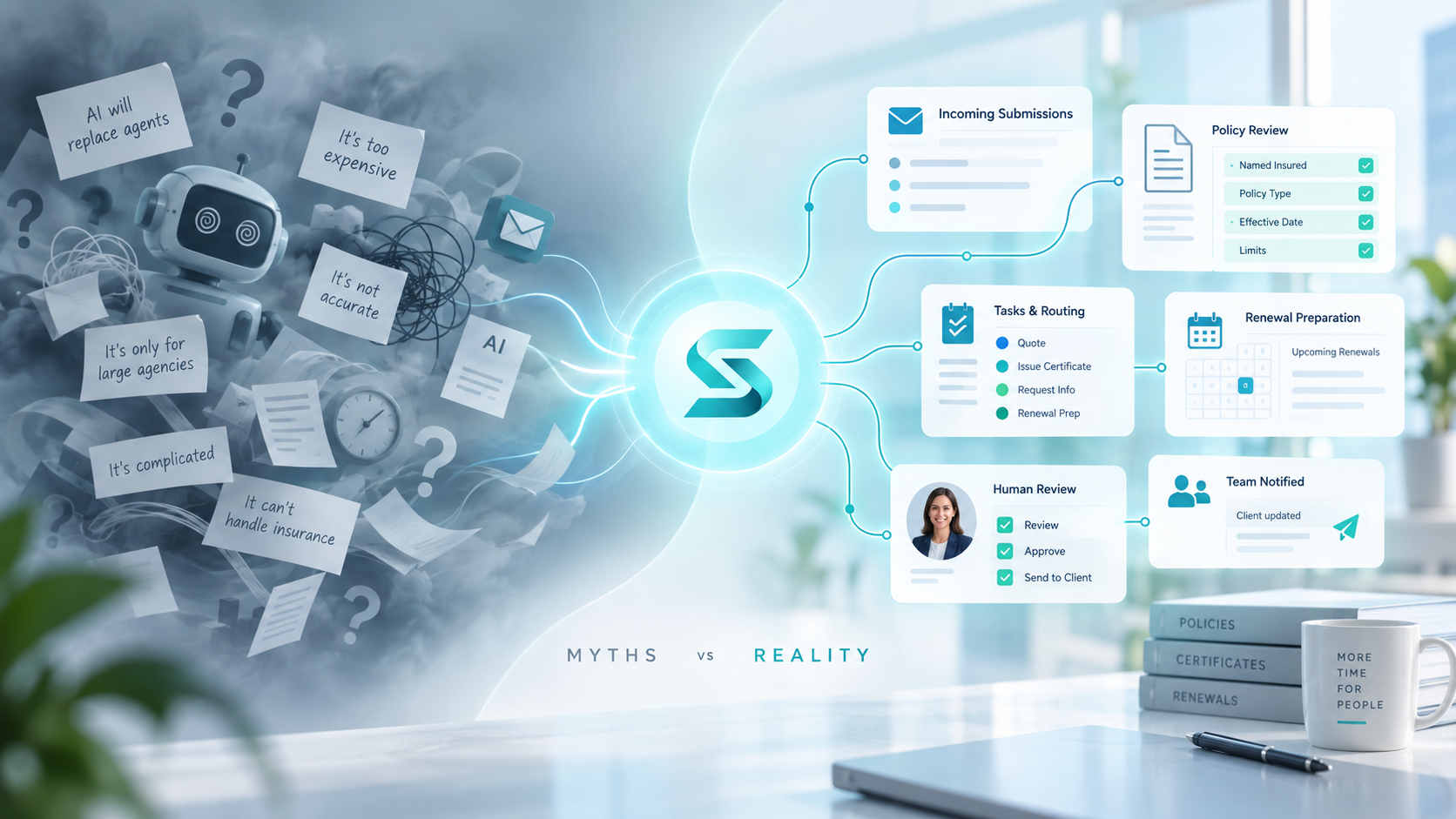
AI is getting a lot of attention, but that also means insurance agency owners are hearing a lot of conflicting information.
Some people make AI sound like it can automate an entire agency overnight. Others assume it is little more than a chatbot or writing assistant.
The reality sits somewhere in the middle.
For commercial insurance agencies, AI is most useful when it is applied to specific workflows where employees spend time reading, organizing, extracting, routing, drafting, and following up on information.
That could mean helping with a busy service inbox, reviewing documents, organizing endorsement requests, preparing renewal information, or identifying missing details before a request reaches an account manager.
Here are some of the most common myths about AI automation and what agencies should realistically expect.
Myth 1: AI Automation Means Replacing Employees
This is probably the biggest misconception.
Most insurance workflows still require human judgment.
Coverage decisions, client communication, policy changes, exceptions, approvals, and other important actions should not simply be handed over to AI without the right controls.
The better use of AI is to handle repetitive work around the employee.
For example, imagine a client sends an endorsement request.
Before the account manager even opens the email, an AI workflow could:
- Read the request
- Identify that it is an endorsement
- Extract the requested change
- Check whether important information appears to be missing
- Create an organized summary
- Route the request to the appropriate employee
- Prepare a draft response for review
The account manager still makes the decisions.
They just do not have to start from an unstructured email every time.
Reality: AI should give experienced employees more leverage, not remove them from the process.
Myth 2: Agencies Have to Replace Their Current Software
Many agencies assume adopting AI means replacing the AMS, CRM, email system, document storage, or other tools they already use.
That usually should not be the starting point.
A practical automation is often built around the systems the agency already uses.
For example:
Outlook or Gmail → AI processing → workflow automation → CRM or AMS → team notification
The goal is to connect the steps that employees currently perform manually.
If an employee receives information in Outlook, copies it into another system, creates a task, notifies a coworker, and sends a follow-up email, there may be an opportunity to automate some of those handoffs without replacing the underlying software.
Reality: Good automation should fit the agency's existing process wherever practical.
Myth 3: AI Can Run Everything on Autopilot
AI is not perfectly accurate.
That matters even more in insurance, where mistakes can affect clients, coverage, service quality, or financial outcomes.
An AI workflow should be designed based on the risk of the task.
There is a big difference between:
AI categorizing an email
and
AI making a coverage-related decision without review.
The first may be reasonable to automate heavily.
The second should have strong human controls.
A practical workflow might look like this:
Request received → AI reads and organizes → business rules are applied → employee reviews → approved action occurs
The amount of human review can change depending on the workflow.
Reality: The goal is controlled automation, not blind automation.
Myth 4: You Need a Huge AI Transformation to See Value
You do not need to automate the entire agency.
In fact, that is usually the wrong place to start.
A better first project is one workflow that is:
- Repetitive
- Frequent
- Clearly defined
- Taking meaningful staff time
- Measurable
- Reasonably safe to automate
For many commercial insurance agencies, that might be:
- Service inbox triage
- Document processing
- Certificate request intake
- Endorsement intake
- Missing information follow-up
- Renewal preparation
Start with one process.
Measure what changes.
Then decide whether expanding makes sense.
Reality: One useful workflow is better than a large AI project with no clear business case.
Myth 5: AI Is Mostly for Chatbots and Writing Emails
Generative AI made chatbots and writing assistants popular, but business automation can go much further.
AI can help software understand information that previously required someone to read it manually.
That makes it useful for insurance because so much of the industry's work involves emails, PDFs, attachments, forms, and unstructured information.
For example, an AI workflow could review a policy document and extract:
- Named insured
- Policy number
- Effective dates
- Coverage information
- Locations
- Vehicle information
- Important notes
- Missing fields
Or it could review an incoming email and determine:
- What the client is asking for
- Which account it relates to
- Whether the request is urgent
- What information was provided
- What appears to be missing
- Who should handle it
That information can then be passed into the rest of the workflow.
Reality: AI becomes much more useful when it is connected to actual business processes.
Myth 6: AI Automation Has to Mean Giving Up Control of Your Data
Data handling should absolutely be part of the conversation.
Commercial insurance agencies handle sensitive client and policy information, so automation should not be built casually.
A responsible implementation should consider:
- What information the AI provider receives
- Which business or API accounts are being used
- Where information is stored
- Who owns the production accounts
- What permissions the automation has
- Whether data needs to be retained
- Which actions require human approval
Where practical, production systems, accounts, credentials, and data should remain under the client's control.
The agency should understand how information moves through the workflow before it goes live.
Reality: AI automation does introduce new data considerations, but those risks can be managed through proper system design, access controls, testing, and human review.
Myth 7: Every Repetitive Task Should Be Automated
Just because something can be automated does not mean it should be.
Some processes happen too infrequently to justify the effort.
Others change constantly.
Some require too much judgment.
And sometimes the automation would cost more than the problem it solves.
That is why agencies should look at the business case first.
A useful starting calculation is:
How often does this happen?
How much employee time does it take?
How many people touch the process?
What happens when it is delayed or missed?
Would improving it meaningfully affect capacity, response time, service quality, or revenue?
If the value is unclear, keep looking.
Reality: The best automation opportunities are tied to measurable operational pain.
Myth 8: The Only ROI Is Reducing Headcount
Saving labor is one benefit, but it is not the only one.
For an insurance agency, automation may create value through:
- Faster response times
- Fewer missed requests
- Better task visibility
- More consistent processes
- Less copying and re-entering information
- Faster document review
- Fewer repetitive follow-ups
- More capacity for existing staff
- More time for client-facing work
Consider a service team that spends several hours every week sorting and preparing incoming requests.
The goal does not have to be eliminating a position.
The goal may simply be giving that team those hours back so they can handle more accounts, respond faster, or spend more time on higher-value service work.
Reality: Good automation creates operational capacity.
What a Practical AI Workflow Can Look Like
A useful AI workflow usually combines several pieces.
Before automation:
Client request → employee reads email → checks attachments → searches for information → determines next step → creates task → routes request → writes response
With AI automation:
Client request → AI reads and organizes → missing information is flagged → task is created → appropriate employee is notified → response is drafted → employee reviews
The employee stays involved where judgment matters.
The repetitive preparation work happens automatically.
That is the difference between simply "using AI" and actually improving a business process.
Where Insurance Agencies Should Start
Do not start with the most impressive AI idea.
Start with the process your team complains about.
Look for work that involves repeated:
- Reading
- Sorting
- Copying
- Extracting
- Routing
- Updating
- Drafting
- Following up
Then map the process from beginning to end.
Once you understand what actually happens, you can determine which steps could reasonably be automated and which should remain human-reviewed.
For many commercial insurance agencies, the service inbox and document workflows are strong starting points because they sit at the center of so much daily administrative work.
The Reality of AI Automation
AI automation is neither magic nor something insurance agencies should ignore.
It is another operational tool.
Used poorly, it creates unnecessary complexity.
Used well, it can reduce repetitive administrative work and give employees a better starting point for the work that actually requires their expertise.
The question is not:
"How much AI can we add to the agency?"
The better question is:
"Which parts of our current process are wasting the most time, and could AI help?"
Susalix AI is an OpenAI Select Partner focused on practical AI workflow automation for commercial insurance agencies. We help agencies identify repetitive processes, determine where automation makes sense, and build workflows around the systems their teams already use.
Want to See Where AI Could Help Your Agency?
If your team spends too much time sorting emails, reviewing documents, entering information, routing requests, or following up on repetitive work, there may be an opportunity to simplify the process.
Schedule a call with Susalix AI to see where AI automation could save your agency time.
See where AI automation could save your agency time.
Schedule a CallKeep reading